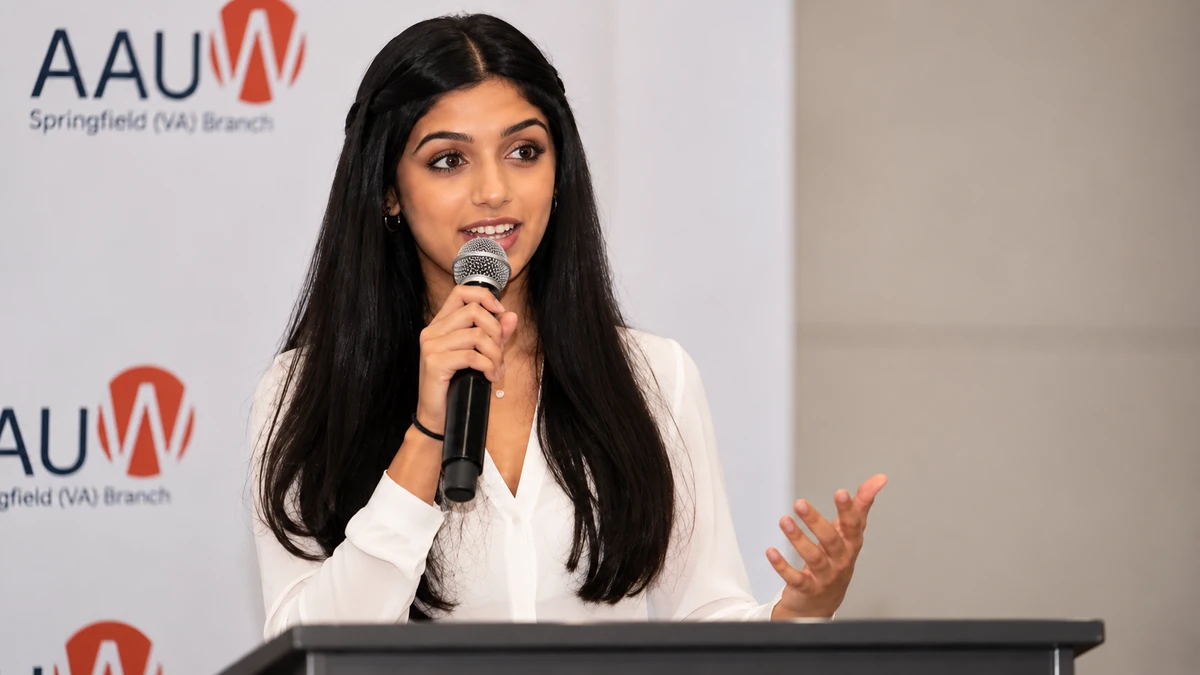
Virginia high school senior Navya Tuteja built Raaha after seeing how invisible disabilities can shape people’s experiences at work. The free AI-powered platform now helps job seekers evaluate whether a role fits how they actually work.
At 17, Navya Tuteja is confronting a problem that established recruitment platforms have often left to job seekers to solve themselves: whether a workplace will actually suit the way a person thinks, communicates and works.
The Virginia high school senior is the founder of Raaha, a free AI-powered platform designed initially with neurodivergent job seekers in mind. Users can compare a job description with their working preferences across factors including schedule predictability, task structure, communication style and work environment.
Tuteja launched the platform this summer. By early August, more than 200 people had used it. Less than two months later, Fortune reported that Raaha had surpassed 1,000 users and included 20,000 job listings, marking rapid early adoption for a product its teenage founder bootstrapped herself.
Behind those numbers is a founder story shaped less by an interest in AI itself than by a problem Tuteja had watched for years.
Her Mother’s Experience Inspired the Idea for Raaha
Tuteja’s motivation began at home.
Her mother is hard of hearing, and Tuteja said that as she grew older, she became more aware of the difficulties her mother encountered obtaining workplace accommodations for a disability that other people could not readily see. She later observed similar issues among students whose different ways of thinking were sometimes interpreted as a lack of capability rather than a need for different support.
That experience led Tuteja toward neurodiversity advocacy and eventually toward a specific weakness she saw in the job-search process.
Job listings typically provide information such as responsibilities, qualifications, salary, location and benefits. They are often much less explicit about what everyday work will feel like: whether priorities frequently change, communication is predominantly written or verbal, schedules are predictable, tasks are highly structured or the environment requires extensive multitasking.
For neurodivergent candidates, those details can materially affect whether a role is sustainable.
Tuteja decided to make that missing information the product.
“Raaha,” which she has described as meaning “path” in Hindi, asks users about how they prefer to work and analyzes job descriptions against those preferences.
Raaha Evaluates the Job, Not the Applicant
That distinction is central to Tuteja’s approach.
Traditional recruiting technology frequently evaluates whether a candidate matches an employer’s requirements. Raaha reverses the direction: it evaluates the characteristics of the job for the candidate.
The platform’s current website says it examines areas including schedule predictability, task structure, multitasking load, work pace, communication style, work environment, and flexibility and change. Users complete a work-profile questionnaire and paste in a job description before receiving a fit analysis.
Raaha says its objective is to identify what appears compatible with the user’s preferences, what may present difficulties and what the job posting does not explain.
The product is explicitly positioned as decision support rather than an assessment of an individual’s capabilities. Its website summarizes the principle as evaluating “job structures, not people.”
Earlier reporting provides more detail about the technology behind the product. WTOP reported in August that job information was processed using Anthropic’s Claude, with a prompt Tuteja developed with input from neurodiversity specialists.
Tuteja Built the Core Logic Herself
Tuteja’s age inevitably makes her unusual among technology founders, but another part of her story is particularly relevant in the generative-AI era: how much of the product she built herself.
According to Fortune, Tuteja wrote Raaha’s underlying algorithm and used generative AI primarily for more mechanical development tasks, including aspects of the website’s design.
That division reflects her broader attitude toward AI.
Tuteja attends Thomas Jefferson High School for Science and Technology in Northern Virginia and serves as president of her school’s AI club. Yet her school’s Wi-Fi blocks ChatGPT, Claude and similar tools, Fortune reported. She told the publication that the restriction reduced her use of generative AI during school and forced her to continue doing exam-related thinking independently.
Her position is more nuanced than simply opposing or embracing AI. Tuteja uses the technology for tasks such as drafting emails and organizing information while deliberately keeping it out of her academic learning. She also told Fortune she does not believe banning AI is the long-term answer, instead arguing for appropriate regulation and responsible use.
For a founder whose product incorporates AI, that distinction is consequential. Raaha’s proposition depends not on replacing human judgment but on extracting information from job descriptions that candidates can use to make their own decisions.
From 200 Users to More Than 1,000
Raaha’s initial growth provides an early indication that Tuteja identified a problem extending beyond her immediate community.
On August 7, the platform had attracted more than 200 users after approximately a month in operation. By September 27, Fortune reported more than 1,000 users and a database of 20,000 job listings.
The platform remains free for job seekers.
Tuteja has bootstrapped Raaha rather than raising outside funding, according to Fortune. Her longer-term commercial model could involve employers and workforce organizations paying to use the platform or improve how their job listings communicate workplace conditions.
That model would create an interesting second side to the business.
Raaha currently helps candidates interpret information employers provide. Over time, aggregated insights about what job descriptions routinely fail to explain could potentially help organizations write clearer listings in the first place.
Tuteja has already described labor-market transparency as the larger ambition. In a September interview with Diversability, she said she wants checking Raaha before applying for a position to become as routine as researching an employer before an interview. She also expressed interest in studying patterns across job descriptions to determine which provide useful information about working conditions and which leave important questions unanswered.
Raaha Is Only One Part of Tuteja’s Work
The startup is not Tuteja’s first project addressing accessibility.
She founded Empower InvisAbilities, a nonprofit involved in STEM workshops and educational inclusion for neurodivergent people, and wrote a children’s book centered on neurodivergence.
Fortune reported that Tuteja developed a proposed transparency framework called Traceable Accessibility and has discussed her ideas with policymakers, including the U.S. Department of Education.
Taken together, the projects reveal a consistent pattern in her work. Tuteja is not simply looking for places where AI can automate existing tasks. She is looking for information asymmetries—situations where people struggle because systems do not clearly communicate what they need to know.
A Founder Building Before College
Tuteja remains a high school senior and intends to attend college, according to Fortune. She has also left open the possibility of working on Raaha full-time if its growth continues.
That means Raaha is still at a particularly early stage. Its first 1,000 users demonstrate interest, not yet the durability of its business model. Questions remain around how the platform will scale, how employers might participate, and whether its analysis can maintain usefulness across different occupations and workplace environments.
But the company already illustrates something broader about the falling barriers to technology entrepreneurship.
Generative AI and accessible cloud tools can allow individual developers to build products that previously would have required larger engineering teams. That does not eliminate the need for original insight. If anything, easier software creation makes identifying a worthwhile problem more important.
Tuteja’s approach to Raaha offers a clear example.
The technology matters, but the starting point was not a model or an AI trend. It was watching her mother navigate a workplace that did not always make room for an invisible disability—and recognizing that job seekers often make consequential career decisions without knowing what the workplace on the other side of an application will actually be like.
At 17, Tuteja is attempting to turn that observation into a company.
Related Stories

Baselayer Raises $35M Series A to Build Identity Infrastructure for AI Agents

Steadily Builds Digital Insurance Platform Around America’s Landlords
How Palmer Luckey Took a Silicon Valley Playbook Into the Defense Industry