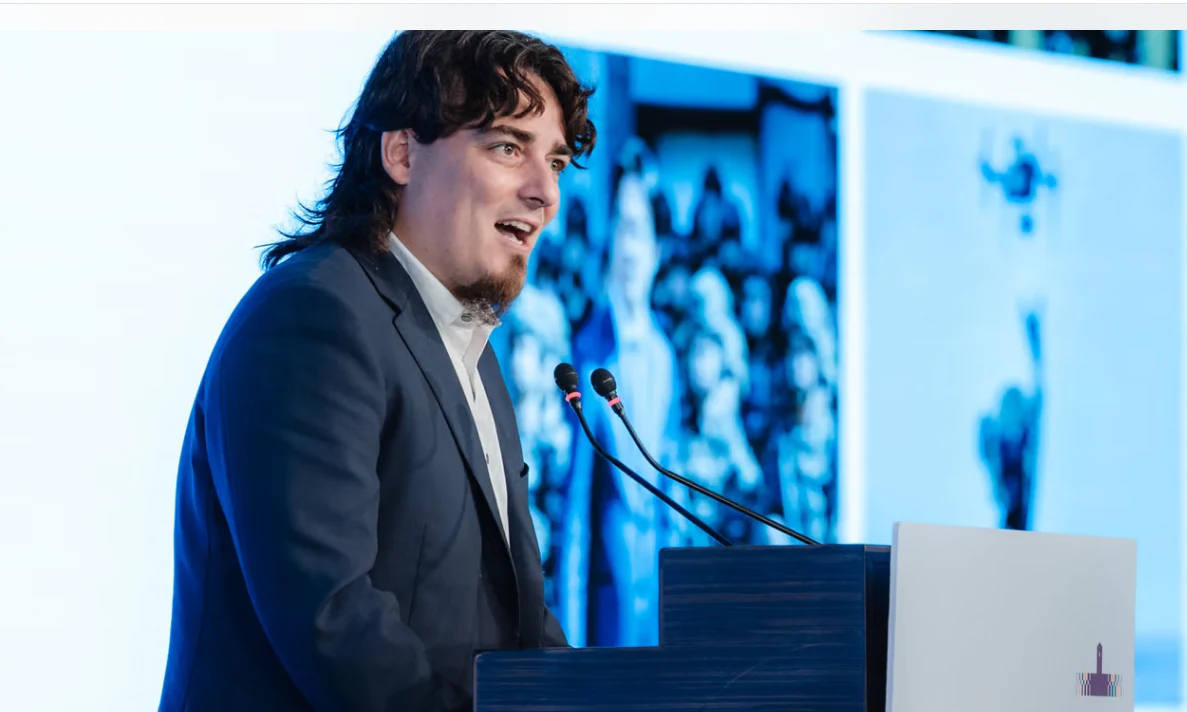
After building Oculus VR, Palmer Luckey co-founded Anduril Industries in 2017 around a different proposition: that defense systems could be developed with the speed, software focus and private-risk model associated with technology companies. Nine years later, Anduril has expanded across autonomous aircraft, underwater systems, sensors, weapons and AI command-and-control—and its valuation has climbed far beyond the $10 billion figure associated with its earlier funding rounds.
Palmer Luckey was already one of technology’s best-known young founders when he turned his attention from virtual reality to national security.
After creating Oculus VR and selling the company to Facebook, Luckey co-founded Anduril Industries in 2017 with Brian Schimpf, Trae Stephens, Matt Grimm and Joe Chen. Their goal was unusually ambitious for a startup: build a new defense company capable of competing in an industry dominated by contractors with decades of history and deeply established government relationships.
At the center of the strategy was a belief that future military systems would increasingly be defined by software, artificial intelligence and autonomy rather than hardware alone. Anduril says it was founded around principles of speed and innovation, with software at the core of future weapons systems.
Nine years later, the company has moved considerably beyond its startup origins. Reuters reported in July 2026 that Anduril had reached a $61 billion valuation following a $5 billion financing, while discussions were underway for another potential funding round at a substantially higher valuation. The company had reported $2.2 billion in 2025 revenue, according to Reuters.
That makes the previously cited $10 billion valuation and $2.8 billion funding total historical rather than current measures of Anduril’s scale.
Luckey’s Path From Virtual Reality to Defense
Luckey’s interest in military technology predates Anduril.
Before Oculus became synonymous with consumer virtual reality, his work exposed him to applications of immersive technology beyond entertainment. His experience included the USC Institute for Creative Technologies’ Mixed Reality Lab, where virtual-reality research included applications connected to military personnel and veterans.
Luckey subsequently built Oculus around the idea that virtual reality hardware could become dramatically more capable and accessible. Facebook acquired Oculus in 2014.
That experience would eventually influence the model behind Anduril: rather than approach defense solely as a government contracting business, Luckey and his co-founders sought to apply elements of the commercial technology industry’s approach to product development.
Anduril describes that philosophy as building products ahead of specific government requirements, privately financing research and development and offering completed systems to customers rather than waiting for a government agency to fund every stage of development.
The approach shifts more development risk onto the company, but it can also allow products to move from concept to deployment faster when the model works.
Lattice Puts Software at the Center
Anduril is often associated with drones, surveillance towers and autonomous aircraft, but its defining technology is software.
Lattice is the company’s AI-enabled software platform, designed to integrate information from sensors, networks and other systems into a common operational environment.
Anduril says Lattice can ingest data from disparate systems and use AI, machine learning and data-processing techniques to surface important information to operators. Those operators can then use the platform to task connected sensors, vehicles and other assets.
Earlier deployments included security systems along the U.S. southern border and military installations. The company has described Lattice as capable of detecting, classifying and tracking objects while presenting human operators with information and potential responses.
The architecture is important to understanding Anduril’s broader strategy.
Instead of treating every drone, sensor or autonomous vehicle as an isolated product, the company is building a software layer capable of connecting systems across different physical domains.
That means a sensor detecting something in one location can potentially feed information into a common operating picture while other autonomous systems respond to the information.
It is closer to an operating-system philosophy than a conventional standalone weapons program.
Anduril Has Expanded Far Beyond Surveillance
The hardware surrounding Lattice has grown substantially since Anduril’s early years.
Its portfolio now extends across autonomous aircraft, sensing systems, counter-drone technology, underwater vehicles and other defense products. The company has also expanded through acquisitions, including its purchase of autonomous underwater vehicle developer Dive Technologies and, in 2025, infrared technology company American Infrared Solutions.
That expansion demonstrates an important part of the Anduril model: software-defined defense still requires sophisticated physical manufacturing.
Artificial intelligence can coordinate a drone, but the aircraft still has to be engineered, manufactured and maintained. The same applies to sensors, underwater vehicles and other autonomous systems.
Anduril is therefore attempting to combine two businesses that historically developed very differently: fast-moving software and capital-intensive defense manufacturing.
That challenge becomes larger as contracts move from demonstrations and smaller deployments into production at scale.
Reuters reported in late 2025 that newer defense technology companies were gaining ground with the Pentagon but still accounted for a small portion of overall contracting, while established defense primes continued to control more than 90% of contracts. The report identified scaling manufacturing as a central challenge for the newer generation of defense companies.
A Different Approach to Defense Procurement
Anduril’s business model is as important to its founder story as its technology.
Traditional government procurement can involve detailed specifications, competitive processes and development programs extending across years. Anduril’s stated model is to identify military requirements itself, finance development privately and present customers with products that are already substantially developed.
That resembles commercial technology more closely than conventional cost-plus defense development.
It also creates different incentives.
If Anduril invests its own money before securing a customer, the company carries the financial risk if a product fails to find sufficient demand. The potential advantage is that successful products can be developed and updated without depending on a government-funded development cycle at every stage.
The company has applied the approach internationally as well.
In Taiwan, for example, Anduril said it produced Altius systems at financial risk and delivered an initial tranche within six months of contract signature. It has also established a local office and expanded relationships with Taiwanese suppliers.
The company has similarly expanded in South Korea, opening a Seoul office and establishing local industry partnerships.
Anduril’s Valuation Has Risen With Its Ambitions
Anduril’s financial trajectory illustrates how dramatically investor attitudes toward defense technology have changed.
In June 2021, the company announced a $450 million Series D at a $4.6 billion post-money valuation. Investors included Elad Gil, Andreessen Horowitz, 8VC, Founders Fund, General Catalyst, Lux Capital, Valor Equity Partners and D1 Capital Partners.
By June 2025, its valuation had reached approximately $30.5 billion following a $2.5 billion financing, according to Reuters.
The acceleration continued.
Reuters reported in July 2026 that Anduril had recently completed a $5 billion round at a $61 billion valuation, led by Thrive Capital and Andreessen Horowitz, and was discussing another financing that could potentially value the company at around $100 billion. The prospective transaction had not been finalized, and Anduril said at the time that no decision about future financing had been made.
That distinction is important: $61 billion is the latest completed valuation identified in the reporting reviewed for this article; roughly $100 billion referred to financing discussions, not a confirmed valuation.
Reuters also reported that Anduril generated about $2.2 billion in revenue in 2025 and had doubled its workforce.
Those numbers place the company in a very different category from the $10 billion startup described in earlier profiles.
Palmer Luckey Is the Founder, but Brian Schimpf Runs the Company
Anduril’s public identity remains closely associated with Luckey, but its leadership structure differs from the founder-led CEO model common among technology companies.
Brian Schimpf, another Anduril co-founder, serves as chief executive.
In January 2025, the company expanded its senior leadership structure, naming Christian Brose president and chief strategy officer and Matthew Steckman president and chief business officer. Anduril said the appointments reflected the increasing complexity of its growth and operations.
Luckey continues to play a highly visible role as founder, particularly around technology, major programs and international expansion.
His Oculus background has also remained relevant.
Anduril’s work with Microsoft on the U.S. Army’s Integrated Visual Augmentation System brought Luckey back into military mixed-reality technology. Anduril said his experience with commercial VR and AR systems was part of the initiative, with Luckey describing the project as a major priority.
It represents an unusual circle in his career: immersive technology helped introduce Luckey to military applications before Oculus, and military mixed reality eventually became part of his work at Anduril.
Manufacturing Is Becoming as Important as AI
Anduril’s next phase is increasingly about production.
The company’s central thesis may be software-defined defense, but software alone cannot supply militaries with aircraft, autonomous vehicles, sensors and other physical systems in large quantities.
Recent partnerships illustrate that emphasis.
In September 2026, Anduril and Voyager Technologies announced a strategic partnership covering advanced weapons and propulsion, with manufacturing and high-rate production identified as central objectives. The companies said they were combining substantial investments in testing and production infrastructure.
Anduril has also pursued international production relationships. Its planned joint venture with the UAE’s EDGE Group, for example, is intended to combine autonomous systems with Lattice while establishing local production for relevant systems, subject to required government approvals.
This is where Anduril’s ambitions face perhaps their most consequential test.
Developing an innovative prototype quickly is one challenge. Producing complex defense hardware reliably, at high volume and across multiple programs is another.
The traditional defense companies Anduril set out to challenge possess enormous manufacturing networks, regulatory experience and decades-long customer relationships.
Anduril is attempting to prove that a newer company can develop those capabilities without losing the speed that distinguished it in the first place.
From Consumer Technology Founder to Defense Industrialist
Luckey’s career now spans two technology shifts that initially appeared unrelated.
Oculus helped establish modern consumer virtual reality. Anduril is attempting something considerably larger and more difficult: building a new-generation defense company around software, autonomy and high-rate manufacturing.
The transition also illustrates a broader change in Silicon Valley.
Defense technology was once a comparatively difficult category for venture-backed startups, partly because of long procurement cycles, regulatory requirements and the capital needed to manufacture physical systems. The growth of Anduril and other defense technology companies has helped demonstrate that significant private capital can be attracted to the sector, even though established contractors still dominate overall Pentagon spending.
Anduril’s trajectory does not prove that the traditional defense model will disappear. Its own expansion increasingly requires capabilities—factories, supply chains, regulatory expertise and large-scale manufacturing—that have long defined the established industry.
What Luckey and his co-founders have demonstrated is that a technology company can become a significant defense supplier by approaching the market from the opposite direction: start with software, finance more development privately, iterate rapidly and then build the industrial capacity required to turn autonomous systems into deployed products.
For Luckey, that makes Anduril more than a second startup after Oculus.
It is an attempt to apply the speed and product philosophy of the technology industry to one of the world’s most difficult and consequential engineering markets.
Related Stories
Baselayer Raises $35M Series A to Build Identity Infrastructure for AI Agents

Steadily Builds Digital Insurance Platform Around America’s Landlords
From Predictive Models to AI Agents: Inside Atrium’s Consulting Strategy