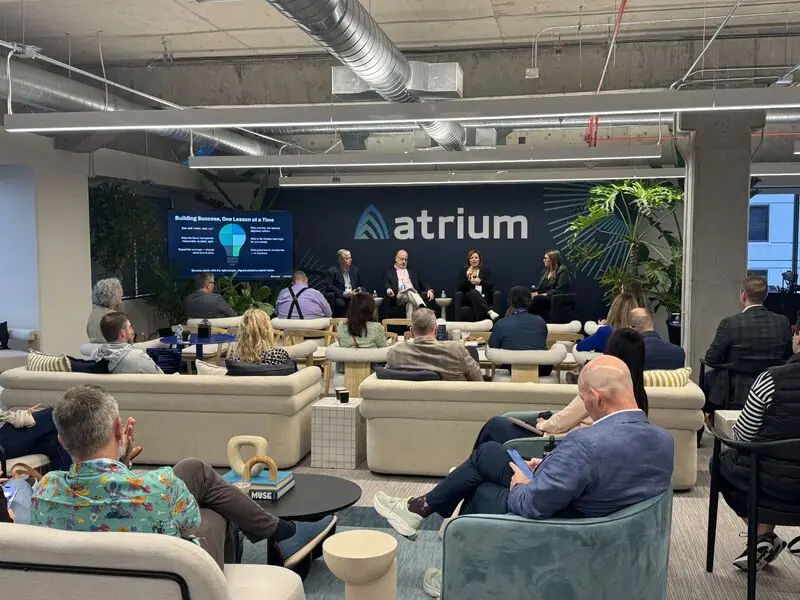
Founded in 2018, Atrium has evolved from deploying predictive models into a global Salesforce and Snowflake consultancy using AI agents inside its own delivery model. Following a recent growth investment from Sverica Capital Management, the company is positioning AI not simply as a client technology, but as infrastructure for how consulting work itself gets done.
When Atrium launched in 2018, generative AI had yet to become a mainstream business technology. The company nevertheless built its consulting strategy around applying data science and artificial intelligence to enterprise operations, initially deploying predictive models and developing teams in the United States and Jaipur, India.
Eight years later, Atrium is attempting something broader: using AI to change not only what a technology consultancy implements for customers, but how consulting work itself is delivered.
The Bozeman, Montana-headquartered company focuses primarily on Salesforce and Snowflake environments, combining human consultants with AI-enabled delivery and proprietary technology. Its most visible example is Andi, an AI agent designed to automate portions of Salesforce development work.
Atrium says its work has now generated more than $1 billion in measurable customer outcomes. That figure comes from the company’s own impact-tracking methodology and should be understood as a company-reported measure rather than independently audited financial performance.
The next stage of that strategy has attracted outside capital. On September 9, 2026, private equity firm Sverica Capital Management announced a strategic growth investment in Atrium. Financial terms were not disclosed.
Atrium Started With AI Before the Generative AI Boom
Atrium‘s current positioning is easier to understand through the company’s development before ChatGPT transformed the technology market.
The company says it launched with a mission to bring AI into front-office operations, establishing teams in the U.S. and Jaipur from its beginning and deploying an early predictive model. By 2019 and 2020, it had opened an office in Bozeman and expanded internationally.
Its platform relationships subsequently became an important part of the business.
Atrium achieved Snowflake Elite Partner status as its data science operations expanded across platforms. The company also built a substantial Salesforce practice and today describes itself as holding high-level partner designations in both ecosystems.
That combination places Atrium in a strategically useful part of enterprise AI adoption.
Artificial intelligence systems depend heavily on the quality, accessibility and governance of underlying corporate data. Salesforce sits close to customer, sales and operational workflows, while Snowflake provides data infrastructure used by large organizations.
Atrium’s opportunity is therefore not limited to building standalone AI applications. It can work where enterprise data, business processes and AI systems intersect.
Chris Heineken and Atrium’s Founding Team
Atrium’s current leadership page identifies Chris Heineken as CEO and co-founder, alongside co-founders Colin Gelfer and Geoff Birnes. The broader leadership team spans sales, marketing, customer success and delivery, people operations and finance.
The company now operates with teams across the United States, India and Latin America, with headquarters in Bozeman and an India office in Jaipur.
Its expansion has been built around a central idea: enterprise AI projects should ultimately be measured by business outcomes rather than simply by whether a new technology was successfully installed.
That philosophy became particularly visible in 2025.
In January of that year, Atrium introduced a public customer-impact dashboard intended to quantify the results associated with its consulting engagements. At launch, Atrium reported approximately $720 million toward a $1 billion customer-impact target.
The company’s website now displays more than $1.037 billion in customer outcomes. Again, this is Atrium’s own measurement of business impact rather than revenue earned by Atrium or an independently verified financial metric.
The distinction matters. But so does the underlying strategic choice: Atrium is attempting to connect consulting work directly to measurable client outcomes instead of emphasizing project size or billable hours.
Andi Brings AI Agents Into Consulting Workforce
The clearest expression of Atrium’s strategy arrived with Andi, its internally developed AI consulting agent.
Atrium introduced Andi publicly in April 2025 as an autonomous agent designed to handle repetitive elements of Salesforce development. The company said the technology could assist with tasks that traditionally consume significant consultant and developer time.
Atrium’s current materials describe Andi as supporting activities including Salesforce development, code reviews, Flow creation and validation rules. The company positions the agent as part of a human-in-the-loop model rather than as a wholesale replacement for consultants.
That distinction points toward a potentially important change in professional services.
Traditional consulting economics have generally connected revenue to people and time: larger projects require more consultants, more hours or both. AI agents potentially weaken that relationship by allowing some repeatable technical work to be completed much faster.
Atrium explicitly argues for a different model. In describing its 2026 repositioning, the company said the next generation of consulting should focus less on conventional billable-hour structures and more on intelligent systems and measurable progress.
Whether that approach produces superior economics at scale remains to be demonstrated. But the model illustrates how generative and agentic AI could affect service businesses themselves—not merely their clients.
Atrium Is Also Using AI Internally
Another notable part of Atrium’s strategy is that it is using AI within its own organization rather than restricting the technology to customer implementations.
A recent Atrium case study describes more than a dozen architects and developers working with Claude while building Andi. It also describes AI use in marketing workflows, where the company has sought to encode organizational standards into repeatable AI-assisted processes. Atrium
The company says it has more than 275 employees globally.
This internal adoption matters because consulting companies occupy an unusual position in the AI transition. They advise clients on changing their operations while simultaneously facing the same technology-driven changes themselves.
A consultancy that automates parts of development, research, documentation or analysis could potentially complete engagements with different staffing structures than were previously required.
That creates a tension across the professional-services industry: AI may expand demand for expertise in implementation and transformation while simultaneously reducing the human labor required for certain pieces of that work.
Atrium is effectively betting that embracing that shift early will be more valuable than protecting the traditional delivery model.
Salesforce and Snowflake Anchor the Business
Despite its emphasis on AI, Atrium remains closely connected to two established enterprise technology ecosystems.
The company provides consulting around Salesforce and Snowflake, spanning areas including strategy, data science, engineering, implementation, system transformation and managed services.
Its Salesforce practice focuses on implementing and optimizing systems while increasingly incorporating AI agents into delivery. Its Snowflake work centers on helping companies organize, prepare and use data for analytics and AI applications.
Atrium’s partner credentials are also central to its positioning. Sverica’s investment announcement described the company as one of a relatively small group of independent firms holding both Summit-level Salesforce and Elite-level Snowflake partner designations. It also said Atrium participates in Salesforce Partner Advisory Boards and the Snowflake Americas Partner Advisory Council.
Those relationships matter as enterprise AI moves from experimentation toward deployment.
Companies may be able to test general-purpose AI tools independently, but integrating them with existing customer records, workflows, permissions and corporate data introduces considerably more complexity.
That implementation layer is where consultancies such as Atrium see a continuing role for human expertise.
Sverica Investment Opens Atrium’s Next Growth Phase
Atrium’s development entered another phase in September when Sverica Capital Management made a strategic growth investment in the company.
The companies did not disclose the size of the transaction or Atrium’s valuation. Chris Heineken is continuing as CEO, while Sverica Managing Partner Jordan Richards and Principal Matt Johnson joined Atrium’s board as part of the deal.
The investment is significant beyond the financing itself.
Sverica is backing Atrium at a point when enterprise consulting companies are having to determine how much of their traditional work can—or should—be performed by AI. Atrium has chosen to make that transformation central to its identity rather than treat AI as another consulting practice layered onto an existing model.
Its evolution illustrates that shift clearly.
Atrium began with predictive models, expanded into Salesforce and Snowflake transformation, adopted generative AI tools internally and then developed an AI agent intended to perform portions of the work traditionally handled by consultants.
The strategic question now is whether those pieces can translate into a durable competitive advantage.
AI Could Change the Economics of Consulting
Atrium’s story is ultimately about a larger change taking place across professional services.
For decades, consulting companies have generally grown by adding skilled people and deploying those people across more client engagements. Software companies, by contrast, can theoretically serve additional customers without increasing their workforces at the same rate.
AI agents create the possibility of pushing consulting closer toward the second model.
That does not mean eliminating consultants. Enterprise transformations involve organizational politics, strategy, data architecture, security, compliance and decisions that remain difficult to reduce to autonomous workflows.
But development tasks that are repeatable, rules-based or heavily documented are increasingly susceptible to automation.
Atrium’s human-plus-agent approach represents one attempt to reorganize around that reality.
The company still needs consultants with Salesforce, Snowflake, data and industry expertise. What may change is how much those professionals can accomplish—and what customers ultimately pay for.
For Atrium, the move from predictive AI in 2018 to agent-assisted consulting in 2026 is therefore more than a product evolution. It is an effort to redesign the operating model of the consultancy itself.
And if that model proves scalable, its significance could extend beyond Salesforce and Snowflake to a much larger question facing the professional-services industry: what happens when the consultants advising companies on AI begin using AI to transform their own jobs?
Related Stories

Baselayer Raises $35M Series A to Build Identity Infrastructure for AI Agents

Steadily Builds Digital Insurance Platform Around America’s Landlords

How Palmer Luckey Took a Silicon Valley Playbook Into the Defense Industry