
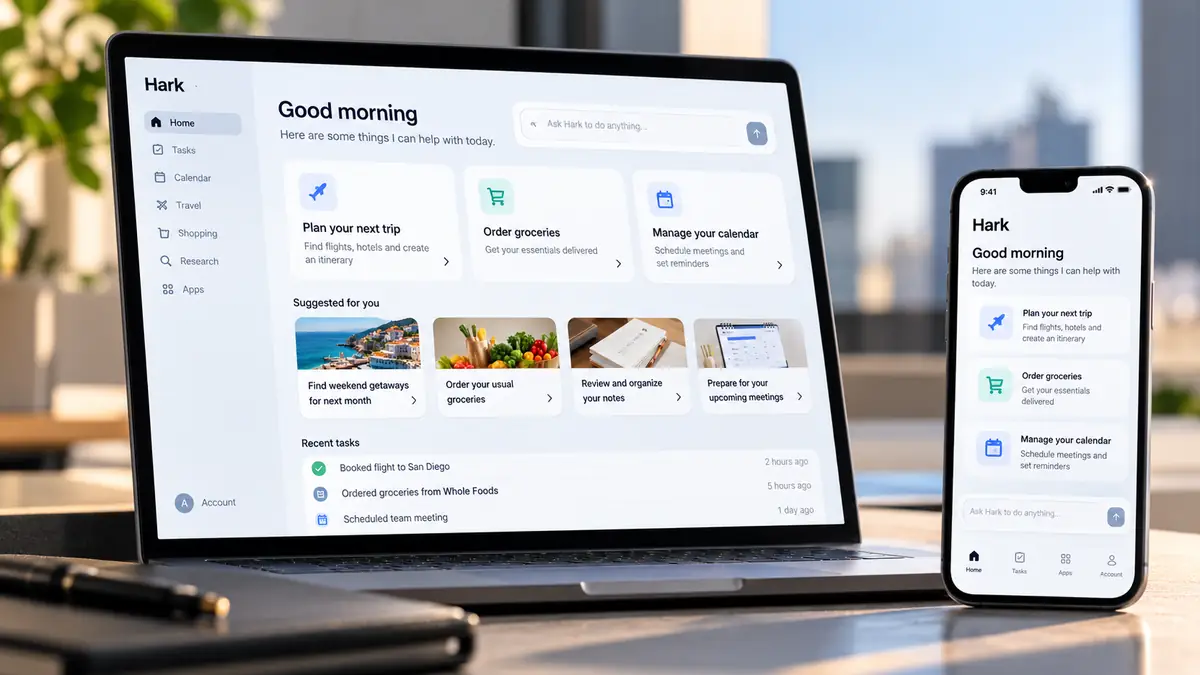
Founded by serial entrepreneur Brett Adcock, Hark has introduced a personal AI assistant designed to anticipate user needs, complete online tasks and establish a software platform for its planned hardware launch in 2027.
Artificial intelligence startup Hark has launched Hark Pro, a personal AI assistant designed to manage everyday activities, remember user preferences and suggest actions before users explicitly request them. Released on October 6, 2026, the application is available on the web, iOS and Android, with free access and optional paid subscriptions.
Hark is positioning the software as the foundation for a broader personal computing platform, with its first physical AI device planned for release in 2027.
Hark Pro Combines AI Memory With Automated Online Tasks
Unlike conventional conversational AI applications that primarily respond to questions, Hark Pro is designed to identify potentially useful actions and carry out digital tasks on behalf of users.
According to the company’s official product announcement, the assistant can help users order groceries, arrange travel, manage calendars, pay bills and organize information across connected services.
The system is powered by Handoff, Hark’s cloud-based computer-use technology, which the company says can operate up to six browser sessions simultaneously and interact with websites on a user’s behalf.
Hark Pro also maintains contextual memory, allowing it to retain preferences and information from previous interactions. This is intended to reduce the need for users to repeat instructions when handling recurring activities.
The application presents suggested actions through a personalized interface featuring interactive panels, task recommendations and controls for approving certain activities.
Users can also create customized mini-applications that display information relevant to their personal or professional routines.
These capabilities reflect a wider shift in agentic artificial intelligence, where software systems are being developed to execute multi-step workflows rather than simply generate responses.
The growing adoption of autonomous AI assistants also reflects a broader transformation in enterprise technology, as businesses move beyond predictive models toward systems capable of executing complex workflows. This shift is evident in Atrium’s use of AI agents in business operations, highlighting how organizations are integrating AI-driven automation into everyday processes.
Brett Adcock Expands Into Personal AI Computing
Hark’s founder, Brett Adcock, has previously established businesses in aviation and robotics.
He founded Archer Aviation, which develops electric aircraft, and later founded Figure AI, which is developing general-purpose humanoid robots.
Hark represents a move into consumer-focused artificial intelligence, where software, model development and potentially dedicated devices could form an integrated product offering.
Adcock initially committed $100 million of his own capital to the venture. The publication also reported a $6 billion valuation, citing Bloomberg, while referencing additional financing reported by Fast Company.
These reported financial figures provide context for the scale of the company’s ambitions, although they should not be interpreted as evidence of established commercial traction.
Hark has also recruited employees with experience at major technology companies, including Apple and Tesla. Its design operations are led by Abidur Chowdhury, a former Apple designer who worked on the iPhone Air.
Hark Plans Dedicated AI Hardware for 2027
The software launch precedes Hark’s planned entry into the AI hardware market.
The company has confirmed that it is developing its first physical product for 2027, although it has not publicly established a final device design, retail price or specific release date.
Chowdhury has indicated that Hark is exploring alternatives to conventional smartphone and wearable interfaces, seeking a computing experience built around AI assistance.
Reporting from Bloomberg, referenced by Quartz, also identified a partnership with AT&T for connectivity associated with Hark’s planned devices.
The strategy suggests that Hark intends to make its assistant accessible beyond existing smartphones and computers, although the practical advantages of a dedicated device will depend on the final hardware and software experience.
For now, Hark Pro provides an initial opportunity to evaluate the company’s approach before any physical product reaches consumers.
Competition Intensifies in the Personal AI Market
Hark enters a competitive market as major technology companies invest in AI systems capable of completing tasks across applications and online services.
OpenAI, Meta and other AI developers are exploring personal agents, more persistent contextual awareness and new interfaces intended to make AI assistance more accessible.
The competition is increasingly extending beyond the underlying language models to include product design, software integration, reliability and user trust.
For Hark, the ability to perform tasks across different websites could provide a useful point of differentiation. However, completing purchases, managing accounts and accessing personal information also creates substantial privacy and security considerations.
Hark says it encrypts sensitive credentials and does not sell users’ personal information to advertisers. These are company representations, rather than independently established guarantees of security.
The broader challenge for the industry is to demonstrate that autonomous assistants can complete practical activities accurately while maintaining meaningful user oversight.
Hark’s decision to release its software before its hardware gives the startup an opportunity to develop user relationships, gather product feedback and refine its approach.
Its next significant milestone will be translating that software experience into a physical device in 2027, as competition for the next generation of personal computing continues to develop.
Related Stories
Elorian Unveils Glimpse After Raising $55 Million for Visual AI Development
Intero Biosystems Wins TechCrunch Disrupt 2026 Startup Battlefield and $100,000 Prize

Dublin International AI Summit 2026 Hosts Global Leaders to Address AI Innovation, Safety and Regulation